That is where hex mesh anchors, hex steel, and refractory hex mesh systems become essential.
At Refractory Anchors Inc. (RAI), we manufacture refractory anchoring solutions designed to help industrial facilities protect critical equipment, extend lining life, and reduce costly downtime. From cyclones and ducts to abrasion-resistant linings and ceramic tile systems, RAI provides the refractory hardware needed when your lining requires extra support.
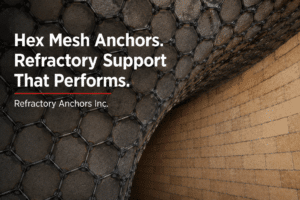
Refractory hex mesh, often called hex steel or hex mesh, is a metal grid system formed in a hexagonal pattern. The open-cell structure helps hold refractory material in place while distributing mechanical stress across the lining surface.
Instead of relying on individual anchors alone, hex mesh creates a continuous reinforcing framework. This makes it especially useful in areas where refractory linings are exposed to severe abrasion, erosion, impact, or high-velocity material flow.
Common applications include:
The hexagonal structure gives the lining a stronger mechanical grip, helping the refractory resist movement, cracking, spalling, and premature wear.
In severe-service equipment, refractory linings can be damaged by constant contact with moving particles, gas streams, catalyst, ash, aggregate, or other abrasive materials. Over time, this wear can thin the lining, expose the shell, and lead to expensive maintenance issues.
Hex steel helps solve this problem by reinforcing the hot-face lining and holding the refractory material in a defined pattern. The metal grid provides added structure, while the refractory fills and locks into the hexagonal cells.
This combination helps improve lining stability in harsh environments where abrasion and erosion are common.
Hex steel is often selected when a lining needs:
For facilities operating cyclones, ducts, and other high-wear equipment, hex mesh anchors can be an important part of a stronger refractory lining system.
Standard refractory anchors are commonly used to secure castable, brick, ceramic fiber, and other refractory systems. They are effective in many applications, but severe abrasion environments often require a more continuous support structure.
The biggest difference between standard anchors and hex mesh systems is how they distribute stress.
Standard anchors support the lining at individual attachment points. Hex mesh anchors create a connected grid across the lining surface. This helps reduce localized stress and provides a stronger mechanical framework for refractory material.
In many systems, standard anchors and hex mesh can work together depending on the lining design, operating conditions, and refractory material being used.
Hex mesh is most valuable when refractory lining failure could be caused by abrasion, erosion, thermal cycling, vibration, or high mechanical loading.
It is commonly used in equipment where materials are moving quickly through the system and repeatedly contacting the lining surface. In these applications, refractory material needs more than adhesion or isolated anchoring. It needs a reinforced structure that helps keep the lining locked in place.
Hex mesh may be recommended for:
If the lining is in an area where wear is concentrated, downtime is expensive, or shell protection is critical, refractory hex mesh may provide the added reinforcement needed.
Proper installation is critical to the performance of a hex mesh lining system. The hex mesh must be securely attached to the equipment shell before the refractory material is installed.
In many applications, hex mesh is welded to the shell at designated attachment points. The goal is to create a stable framework that stays in place during refractory installation, curing, startup, and operation.
Once the hex mesh is secured, the refractory castable, gunned lining, or abrasion-resistant material is installed so it fills and encapsulates the hexagonal cells. This allows the refractory to mechanically lock into the mesh structure.
A properly installed system helps:
For best results, the installation method, weld pattern, alloy selection, refractory material, and lining thickness should be matched to the specific equipment and service conditions.
The best material for a hex mesh or refractory anchoring system depends on operating temperature, chemical exposure, abrasion level, and the refractory lining design.
Common material options include:
Stainless steel and high-temperature alloys are often selected when corrosion resistance, oxidation resistance, or elevated temperature strength is required. In less demanding environments, carbon steel may be suitable depending on the application.
RAI can help customers evaluate material options based on the service environment, operating temperature, lining type, and project requirements.
Yes. Ceramic tile systems can be compatible with hex mesh back-up designs when the lining system is engineered correctly.
Ceramic tile is often used in areas where impact, abrasion, or wear resistance is a priority. When combined with the right anchoring and support system, tile can provide a durable wear surface for severe-service equipment.
Hex mesh may be used as part of a back-up or support configuration to improve lining stability and help distribute mechanical loads. This can be especially helpful in systems where tile, castable, and abrasion-resistant linings must work together under thermal and physical stress.
Compatibility depends on several factors, including:
RAI manufactures refractory hardware for ceramic tile systems, abrasion-resistant linings, and other demanding industrial applications.
Not every refractory lining requires the same support structure. The best system depends on the shape of the equipment, the amount of movement or abrasion expected, and the type of refractory material being installed.
Hex mesh is a strong choice for high-wear areas that need continuous refractory reinforcement. It is commonly used in cyclones, ducts, flues, reactors, and abrasion-resistant linings.
Flexmesh may be used where added flexibility is needed to match curved or irregular equipment surfaces. This can make it useful for complex geometries or areas where a rigid grid may be more difficult to fit.
Ceramic tile systems are often selected for severe abrasion or impact areas. When paired with the proper anchors and back-up support, tile systems can help protect equipment in some of the most demanding operating environments.
For many industrial projects, the right answer is not one product alone. A complete refractory support system may include hex mesh anchors, ceramic tile anchors, castable anchors, welded anchors, and specialty alloy hardware working together.
Refractory Anchors Inc. provides high-quality refractory anchoring products for demanding industrial environments. Our team understands that every lining system must be matched to the application, operating conditions, and maintenance goals.
RAI supports refractory projects involving:
When your refractory lining needs extra support, RAI can help provide the hardware needed to improve performance, increase reliability, and support long-term lining life.
If your equipment operates in a high-temperature, high-abrasion, or high-velocity environment, your refractory lining may need more than standard anchoring. Hex mesh anchors, hex steel, refractory hex mesh, Flexmesh, and ceramic tile systems can provide the added support needed for severe-service applications.
Contact Refractory Anchors Inc. today to discuss your project requirements and find the right refractory anchoring solution for your cyclones, ducts, abrasion-resistant linings, ceramic tile systems, and other demanding applications.